I wanted to make an animation of a wing flapping mechanism. While doing some research about these kinds of mechanisms,
I stumbled upon the TreeSwallowProjects website. On the website they
mention that the feathers on a wing were opening during the upward stroke of the wing to reduce drag. This may be a
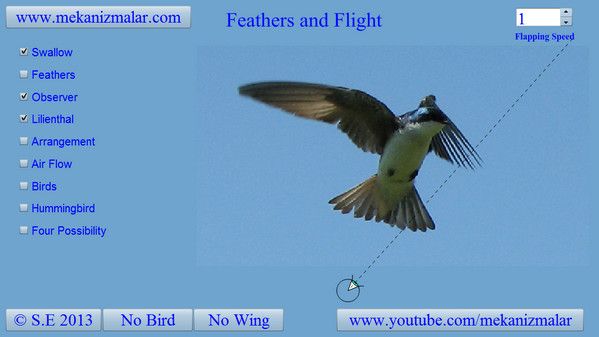
well known concept to some, but was new to me. The swallow picture you see here shows this phenomenon clearly and
I want to thank Chris Gates for giving me the permission to use this image in this animation.
Please take a good look at this image as it plays a very important role in the following explanation.
The wings on a bird are in fact a set of flaps which open when the wing rises and closes when the wing descends.
This means there is less pressure on the wing during the upward stroke than in the downward stroke.
The quill, or the shaft, of a feather does not always lie in the center, but is often well to one side with
a row of feathers arranged so that they overlap and turn somewhat on their shaft.
I wanted to make this animation to show the flap action of feathers. At first, I thought this would be an easy task.
Since I had my wing flapping mechanism, as you see here, I thought the only change required was to add feathers on it,
and show how the feathers were acting during the upward stroke.
Here is the animation of the wing flapping with flight feathers superimposed on it. I based my animation on the figures
shown below from Lilienthal's book, Birdflight, page 101. As you can see flaps are opening on the upstroke to reduce the drag.
The movement of the feather flapping is exaggerated to show you how the feathers operate.
But there is a slight problem here. If you really look at the photo of the swallow, you can clearly see the gaps
between flight feathers. However when viewing the blue bird shown in this mechanism (below), you cannot see between
the feathers.
Either I misinterpreted Lilienthal's drawing or he overlooked some subtle errors in the artist
rendering of the condor wing arrangement. I did not see anything wrong with this arrangement before doing the
animation, but the error manifested itself once I completed the animation.
Apparently, something was not right here. However, the feathers could also be arranged differently than what was
shown in the fictitious blue bird here, and that is the case for all living birds which are represented with red
bird animation here. Notice that now you can see in between the feathers.
All the living birds' feather flap
mechanism works just like the red bird shown here. What is the difference between these two birds? There are two
major differences.
The first difference is that the shaft of the feather, represented by green arcs, is always
away from the bird's body for living red bird, and the opposite for the fictitious blue bird. The second difference
is that, the tip flight feather of the red bird is always fully visible if we look under the bird, and the other
feathers always overlap one another. For the blue bird, the feather closest the bird body is fully visible and the
rest is overlapped. I call the red bird feather arrangement a positive arrangement and the blue birds a negative
arrangement. Also if the shaft of the feather is away from the bird, it will be called a positive feather and will
be shown as a red feather. The blue birds flight feather is such that, the shaft of the feather is always closer
the bird body. These kinds of feathers will be called negative feathers. It will be clear soon why I use the term
positive and negative for feathers and feather arrangements.
If the feathers were acting as a flap, then why don.t we see birds in nature that are like the blue bird? Since
in both cases the flaps are opened in upstroke, there should be a 50/50 chance for both red and blue birds.
However we do not see birds like the blue bird. Maybe it.s because all birds, by luck, descended from one type
of bird and that is why we see only birds like red one in nature. This would be very simplistic explanation.
Or maybe there is more in this than we imagined. As Lilienthal mentioned in his book, in nature any design is
not an accidental one. If nature selects one design over the other, than there must be a solid reason for that.
Let,s start digging into this subtle difference and see why nature selected the red bird over the blue one.
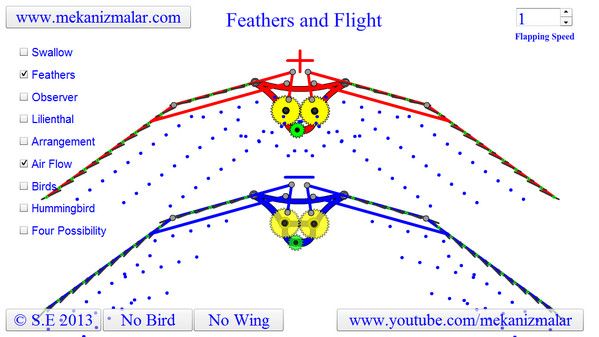
As you can see from these animations, when the feathers are opened in up stroke, the air is pushed toward
under the bird.s body for the red bird, and away from the body for the blue bird. This is a vital difference,
and here is why.
Think for a moment that the blue bird is on the ground, and a predator is approaching. The bird instinctively
flaps its wings to take off. First it is pushing its wings downward, it is also pushing the air under its wing
downward, and it gains slight altitude. But when the bird is in up stroke, the motion of the wing creates a
vacuum under the wing. Since the air under the wing has an outward inertia, due to previous down stroke, does
not have enough time to fill this gap. At the same time the air passing between the feathers going outward,
blocking some of extra air coming toward under the wing; As a result the bird will be sucked downward. This
will nullify all the altitude gain obtained during the wings down stroke and because it did not get enough air
under the wing, the next down stroke will be weaker. The bird will frantically flap its wings, and with each
down stroke it will go up slightly, and fall down with each up stroke. So birds that are like the blue bird
could only fly if they were to jump from a branch off of a tree or from a cliff, taking off from the ground
would be next to impossible for them.
Now let's consider the red bird. When the wings are coming down, whatever happened with the blue bird will
be repeated for the red bird as well. However their up stroke is quite different from blue birds. While the
wings are going up, the opening in the feather will push the air under the bird.s body with a force that,
not only will it will super charge the void with the fresh air from above, it will also give some upward
force to the bird.s body and keep it from falling downward. Also the air coming around and under the bird
toward the void will be assisted by the air coming through the feathers above. I use the term super charge
here, because this is exactly what it is, the power used during the upstroke by the bird is converted
sending more air atoms downward. This has two effects. First, it gives an upward push to the bird much like
a Harrier jet. Second, it accumulates air under the wing for next downward stroke. And the next downward
stroke will take the bird higher. In short, for the red bird, there will be more air atoms to be pushed
downward for each down stroke than the blue bird. Since it is supercharging air under its wing, the red
bird will take off from ground very efficiently. Due to the supercharging effect we call the red bird.s
feather arrangement a positive arrangement.
Feather arrangements also play a crucial role during cruising flight, as mentioned by Lilienthal, both birds,
blue and red, will benefit from the opening of flaps because it will reduce the drag during the upstroke.
Assuming that both birds are flying the same given speed during a cruising flight one may assume that there
are no differences between the two birds. Both birds will get fresh air under their wings due to their
forward speed. However, there is a slight difference between the airflow generated by the upstroke of the wings.
When the blue birds feathers open during the upstroke outward moving air pushes the tip of the feathers
downward and tilts it in such a way that it creates an out and downward air movement. However, with the
red bird this process will create a merging air flow as shown in the figure. This is very important event.
As we know, when an object moves through the air with speed, it creates a low pressure region behind it,
which causes drag that will reduce the speed of the moving object. Therefore the red bird.s air movement
will try to fill the gap behind the bird, reducing the drag. Since the blue bird.s wings are pushing the
air away from the body, it will not fill the gap behind it. This will cause considerable drag on the birdr's
movement. Also, the blue bird is trying to push the air outward, into still air, which might show resistance
to it, and cause the bird to use more force and energy to push the air. On the other hand, the red birds
wings are pushing the air toward a cavity, which needs air, so that it can be filled.
In short filling the void behind a flying bird will reduce the drag and as a result energy consumption of
upward moving wings will be reduced.
The figure given above shows a converging air flow for the red bird and diverging one for the blue one. Is
it a coincidence that these converging lines on the feather have the same direction and almost the same
angle with the barbs on the feather? Is this a freak accident, or are barbs assisting the airflow to be
pushed toward the cavity behind the bird? I have a small hunch that this is the case.
I thank Dr. Bret from the University of Montana, Division of Biological Sciences, for giving me permission
to use the hummingbird picture in a wind tunnel shown above. As you see in this picture the feathers open in the
upward stoke and the airflow converges toward the back of the hummingbird.
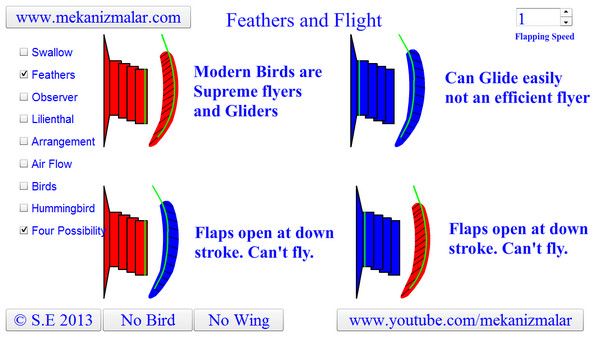
This figure shows four possible combinations of feather arrangements, positive feather arrangement, negative
feather arrangement, positive feather arrangement and negative feather arrangement. Only the red bird has
the capability of taking off of the ground and have efficient flight capability. The blue bird has the
ability to glide but would fly inefficiently. The other combinations are not suitable for flight and or gliding.
As you can see, having two birds identical in their looks, but with very different feather arrangements leads
to a different path in the evolution of birds. If in nature, there were birds like the blue bird we showed
here today they could not compete with the red birds.
The red bird is a master piece of the nature, because nature threw everything in its arsenal to make perfect flying machine.
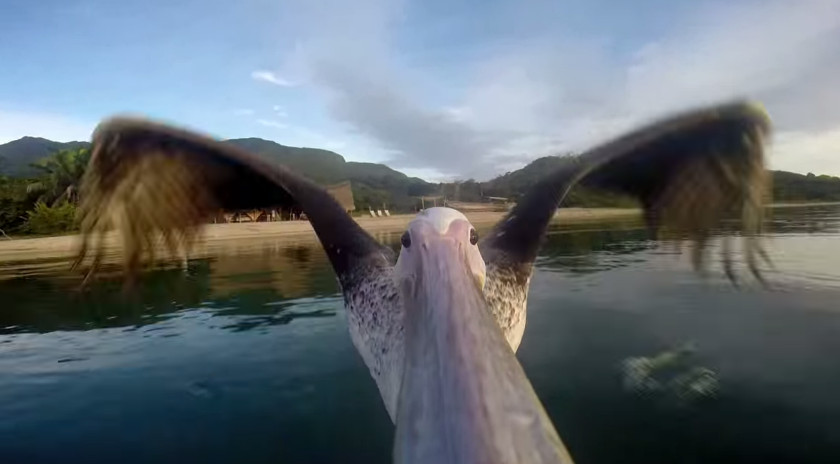
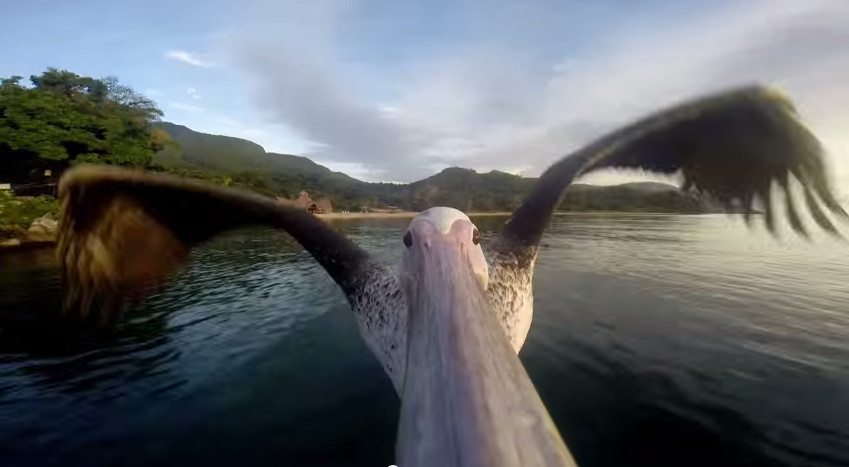
Recently I see following video where a Go Pro camera mounted at the tip of the beak of a pelican.
You can observe opening of the feathers in upstroke. I catch a couple of images from the video for you to see this feather bending phenomenon.






Excellent analysis. I hope to learn more.