How a Simple Plastic Injection Mold works.
The first man-made plastic was invented in Britain in 1861 by Alexander Parkes. He publicly demonstrated it at the 1862 International Exhibition in London, calling the material he produced "Parkesine." Derived from cellulose, Parkesine could be heated, molded, and retain its shape when cooled. It was, however, expensive to produce, prone to cracking, and highly flammable. In 1868, American inventor John Wesley Hyatt developed a plastic material he named Celluloid, improving on Parkes' invention so that it could be processed into finished form. Together with his brother Isaiah, Hyatt patented the first injection molding machine in 1872. This machine was relatively simple compared to machines in use today. It worked like a large hypodermic needle, using a plunger to inject plastic through a heated cylinder into a mold. The industry progressed slowly over the years, producing products such as collar stays, buttons, and hair combs.
The industry expanded rapidly in the 1940s because World War II created a huge demand for inexpensive, mass-produced products. In 1946, American inventor James Watson Hendry built the first screw injection machine, which allowed much more precise control over the speed of injection and the quality of articles produced. This machine also allowed material to be mixed before injection, so that colored or recycled plastic could be added to virgin material and mixed thoroughly before being injected. Today screw injection machines account for the vast majority of all injection machines. In the 1970s, Hendry went on to develop the first gas-assisted injection molding process, which permitted the production of complex, hollow articles that cooled quickly. This greatly improved design flexibility as well as the strength and finish of manufactured parts while reducing production time, cost, weight and waste. The plastic injection molding industry has evolved over the years from producing combs and buttons to producing a vast array of products for many industries including automotive, medical, aerospace, consumer products, toys, plumbing, packaging, and construction
Cold Slug Well of plastic injection molding
Cold slug well of plastic injection molding is divided into the sprue cold slug well and the runner cold slug well. The cold slug well location is generally designed in the end of the sprue or the runner.
Cold slug well are mainly in the form of the bottom with push rod and sprue puller. With a push rod at the bottom of the slag hole is composed of a push rod and push rod mounted on the rod on the fixed panel, so it is often used with a push rod or tube release mechanism, as shown in the figure a, b, c. Another is the bottom of cold slug well formed by a sprue puller, which pull lever core fixing plate, so it's not exercise with the ejection mechanism. Its main bodies are spherical and bacteria sprue puller, as shown in the figure given below.
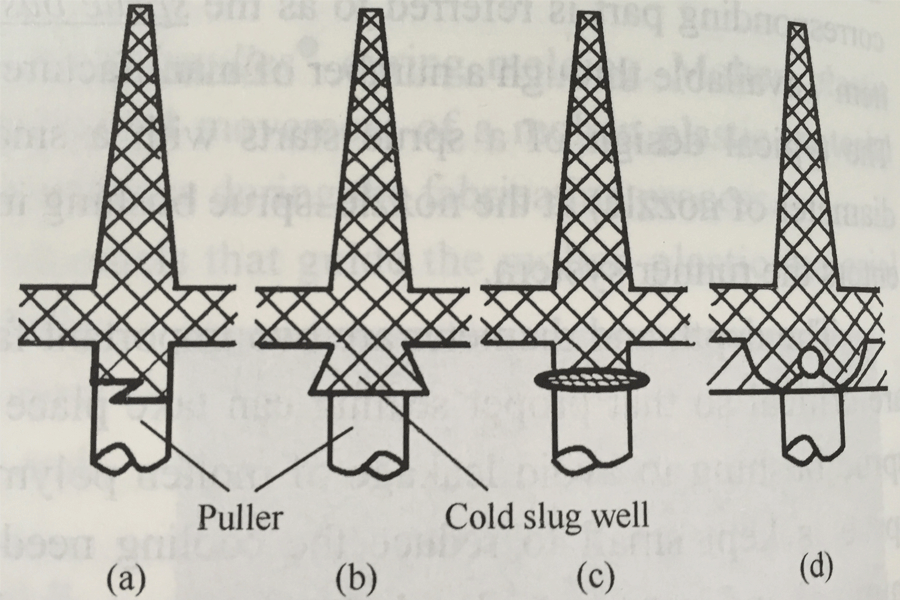
Cold slug well is to gather cold slug to prevent them into the cavity and affect the quality of plastic parts. It can be pushed out from the plastic injection mold with the sprue when demoulding. Cold slug well is to store material flow forwards cold slug. The shape of the sprue cold slug well are the Z-pin (Fig a), the reverse taper (Fig b), the annular ring (Fig c) and the spheral (Fig d). while in the mold opening process to use puller rod or inverted cone etc will be the main runner material pulled from the sprue bushing.